|

|
|
|
|
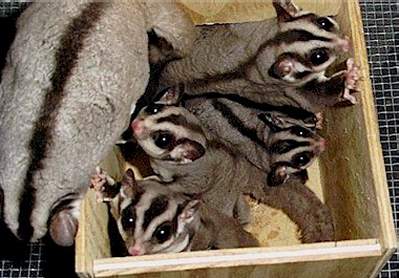
Here
are five of our original family of six
gliders hanging out in the spare nest box. |
|
Our
gliders are all gone now, but I'll keep these pages up in case others find
them
useful as a reference, and in memory of our little guys, who are very much
missed.
|
|
OUR
GLIDERS |
|
Sucrose:
? 1996 - June 4, 2011
Dextrose: September (?) 1997 - October 16, 2002
Geri: January 1999 - June 28, 2003
Pocket: January 1999 - May 19, 2005
Nox: July 1999 - March 16, 2002
Nocturne: July 1999 - December 9, 2010 |
|
HISTORY
|
|
Note:
We firmly believe that exotic animals should not be made into pets, but it
is too late for the sugar glider. They became fad pets in the US and
are now becoming more and more mainstream. We will not go out and
purchase an exotic animal, but we will occasionally take legal
exotics who are abandoned or are in need of a home for other reasons. |
|
We acquired Sucrose in June of 1998 from a friend of ours who had cancer
and was forced to give up some of his animals while undergoing chemotherapy. (He's
doing just fine now!) |
|
Since wild gliders are gregarious animals and do not live alone, we
immediately set about finding Sucrose a mate and soon located a petite, attractive,
outgoing lady glider we named Dextrose. She was a few months younger than
Sucrose and about half his size, but they got along famously right from the start. |
|
In fact, they got along so famously they produced two baby boys in
January of 1999, much to our surprise. Dextrose had been acting a bit more reclusive
than usual, but we weren't sure she had babies until they first came out of the
pouch. We named the babies Geri (after the gliders' godfather Gernot in South
Africa) and Pocket (because it seemed like a good name for a little marsupial, even though
he was a male). We are not into breeding animals, but had been hoping for glider
babies and were delighted the parents obliged. |
|
Geri
was very large, like his Papa, but had his mother's charming, outgoing
personality. Pocket was smaller, like his Mama, but had his father's somewhat shy,
reserved personality - at least, until he got a bit older. |
|
In July of 1999, after Geri and Pocket had reached full size, Mama and
Papa produced two more babies, this time a boy and a girl we named Nox and Nocturne.
Seeing as gliders are nocturnal, night-related names seemed appropriate. |
|
Oddly, Nocturne, like Geri, got Papa's looks and Mama's personality, while
Nox, like Pocket, got Mama's looks and Papa's personality. Nox,
unfortunately, died in March 2002 and his mother, Dextrose, died exactly
six months later. Geri died a year after Dextrose did, and Pocket
two years later. Nocturne, fortunately, lived a good deal longer and
Sucrose reached extreme old age. See the A
Note About Lifespan section below for more details. |
|
Our glider family
didn't increase any further, since we had all of the males neutered. They didn't seem to mind, but it
did make them hard to tell
apart. Unneutered males have a distinctive bald spot in the middle of their
foreheads, but that disappears when they are neutered. The picture at the top of
this page was taken a month or two before Nox, the youngest male, was neutered, and his
bald spot is visible if you look closely. He's on the right side of the box, nearest
the bottom of the picture. |
|
GLIDING |
|
Gliders are equipped with membranes that stretch from the front leg to the
back leg on both sides. These membranes aren't really visible until the glider
stretches its legs out. |
|
In the wild, gliders glide from tree to tree, much like North American
flying squirrels. Our guys didn't do a lot of gliding, perhaps because they
didn't
need to evade predators or work too hard to acquire food. Instead, they tended to
climb or make smaller leaps that didn't require gliding. They were somewhat heavy on
their feet, and when they landed, they landed with a thud as if someone had thrown them. |
|
When moving along the ground,
gliders use an amusing hopping gait.
Sucrose in particular hopped very spastically. He probably wondered why we laughed at
him. |
|
PERSONALITY |
|
Personalities vary from glider to glider, obviously, but in my somewhat
limited experience, gliders tend to be very active, curious creatures. Mine loved to
explore and eagerly investigated anything new in their living area. They liked to
climb on people and occasionally grabbed earrings and bracelets and tried to
pull them
off. I think they were just trying to figure out what the jewelry was. |
|
I've also seen my gliders display what I can only
call a sense of humor. For example, I once observed Dextrose and Geri clinging to
the stucco wall on the porch, taking a rest from hunting bugs. Geri was in front of
Dextrose, and I noticed her eyeing him as if she were devising a plan. After a
couple of minutes, she reached out, grabbed his tail, and gave it a couple of firm yanks,
nearly pulling him off the wall. She could only have done it to amuse herself!
|
|
A lot of people make an effort to bond with
their gliders and turn them into very tame creatures who are attached to their human
"keepers." I don't see anything wrong with this at all, but we used a
different strategy. We wanted our gliders to have more of an attachment to other
gliders than to people and to live together more or less as a family unit would in the
wild. Our guys would still climb on us and would take food from our hands, but they
were not
as cuddly or as trusting of people as "bonded" gliders are. This strategy
worked well for us because we have a lot of other animals who also need attention.
|
|
A NOTE ABOUT LIFESPAN
|
|
When
gliders first hit the US market, they were commonly advertised as having a
lifespan of around 15 years. Recently, people have started backing
down from that figure a bit and saying 10 years is more like it.
That being said, four of our six died much younger than that despite being on a good
diet, getting plenty of exercise, and being part of a "colony"
like they would be in the wild. Two died of early organ
failure. We aren't sure what Geri and Pocket died of, but suspect heart
failure.
|
|
I've
talked to a vet about this and learned that under normal circumstances,
gliders do have an unusually long potential lifespan for creatures their
size. Gliders in the US, however, are almost all descended from a
very small group of animals originally imported to this country. As
a result, inbreeding is a real problem and many of them die much younger
than they should. We think that is what happened in the case of four
of our
gliders. Sucrose and Nocturne were fortunate enough to avoid the "bad
genes."
|
|




|
|

|
|




|